
Nothing Is Free
When a service is free, you are the product. YouTube, Vimeo's free tier, and other free video hosts make their money by showing ads, collecting data, and driving engagement on their platform. Their business model is built around keeping viewers on their site, not helping you sell your product.
For casual video sharing, this is fine. For e-commerce sellers, it is a real problem. Every design decision these platforms make is optimized for their revenue, not yours. And the costs show up in ways that are easy to overlook until you start paying attention.
I have watched sellers struggle with this for years. They upload a product video to YouTube because it is free and familiar, then wonder why it does not seem to help their sales. The answer is usually one of the hidden costs described below.
Competitor Ads Before Your Product
This is the big one. YouTube can and does show pre-roll ads before your video plays. You have no control over what ad appears. It could be a direct competitor selling the same product at a lower price. It could be an unrelated ad that annoys your buyer before they even see your item.
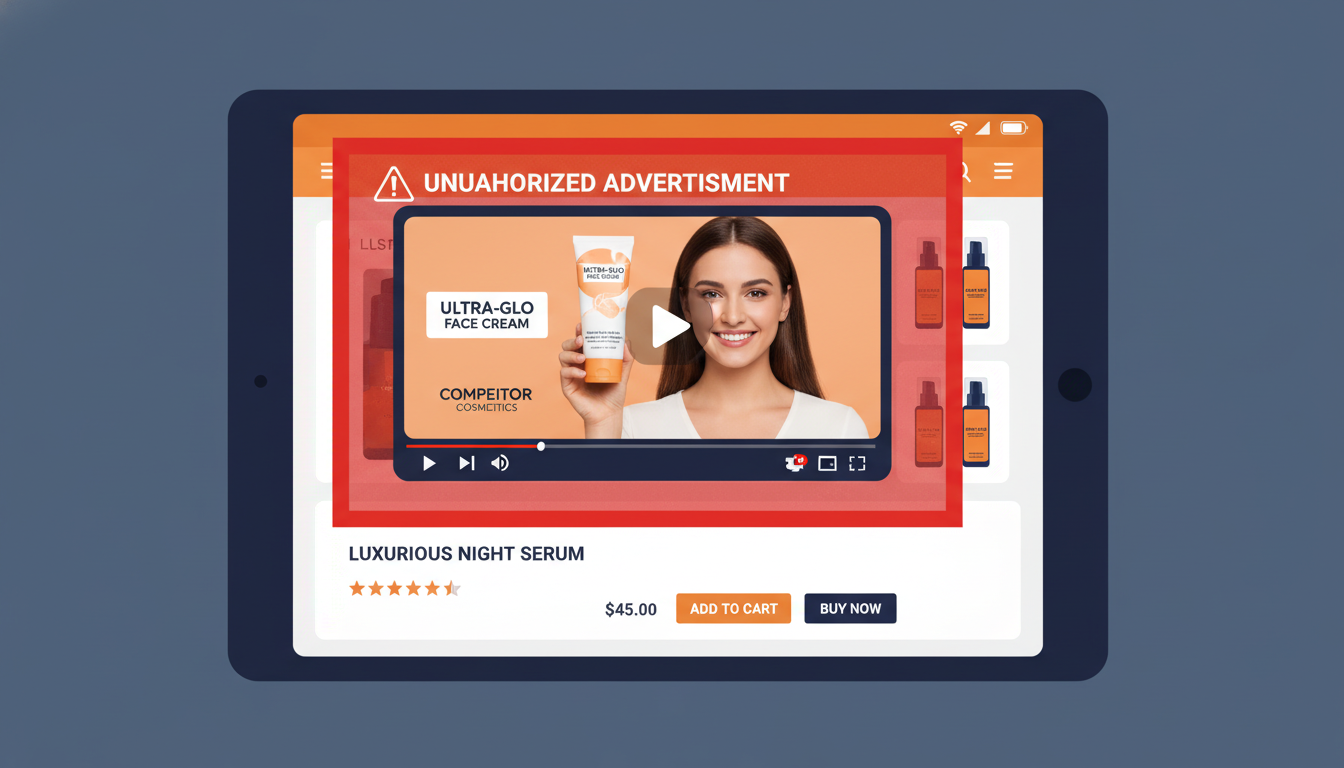
Think about what is happening from the buyer's perspective. They are on your listing, interested in your product, and they click to watch your video. Before they see your product, they see an ad for someone else's product. Even if they skip the ad after five seconds, you have introduced doubt and distraction at the worst possible moment.
There is no way to disable ads on YouTube unless you pay for YouTube Premium — and that only affects your own viewing experience, not your buyers'.
Every buyer who watches your product video on YouTube is potentially seeing a competitor ad first.
Suggested Videos Send Buyers Away
After your product video finishes playing on YouTube, the platform immediately shows a grid of suggested videos. These suggestions are based on what YouTube thinks the viewer wants to see next, not what you want them to see. They often include competing products, unrelated content, or videos that have nothing to do with your listing.
Your buyer came to your listing to evaluate your product. Now they are one click away from watching someone else's review of a competing product. Or a compilation video. Or anything else YouTube's algorithm thinks will keep them on the platform. Every click away from your listing is a potential lost sale.
Vimeo's free tier has similar problems. It shows the creator's other videos and Vimeo branding, which pulls attention away from the purchase decision. For a direct platform comparison, see eCommercePlayer vs YouTube for product listings.
Platform Branding You Cannot Remove
Free video hosts plaster their branding all over the player. A YouTube player includes:
- The YouTube logo — a direct exit ramp off your listing
- A share button — sends buyers to social media
- A channel subscribe button — pulls focus to your channel, not the product
- A link to watch on YouTube — takes the buyer entirely off your page
Vimeo shows its logo and links to the Vimeo platform. These elements are not removable on free plans.
For a product listing, you want the opposite of this. You want the buyer focused on your product with no distractions, no external links, and no reason to navigate away from the purchase decision.
No eBay Support, No Audio Support
Since May 2024, eBay has blocked all iframes in listing descriptions. YouTube embeds are iframes. So are Vimeo embeds. If you sell on eBay, free video hosting is not just suboptimal, it is broken. You literally cannot embed a YouTube or Vimeo player in an eBay listing anymore.
There are workarounds, like linking to a YouTube video from your listing, but that sends the buyer completely off eBay and into YouTube's ecosystem of ads and suggested content. That is even worse than an embedded player with ads. See How to Add Video to eBay Listings After the Active Content Ban for compliant alternatives.
The other gap is audio. YouTube requires you to upload a video file. If you sell vinyl records, musical instruments, music boxes, or anything where sound matters, you have to create a fake video with a static image just to host an audio clip. Vimeo is the same. Neither platform has a native audio player because audio-only content does not serve their ad-supported business model.
eCommercePlayer supports both video and audio players, and the image-link embed method works on eBay because it uses standard HTML elements that eBay allows.
What Purpose-Built Hosting Gives You
Purpose-built video hosting for e-commerce solves all of these problems:
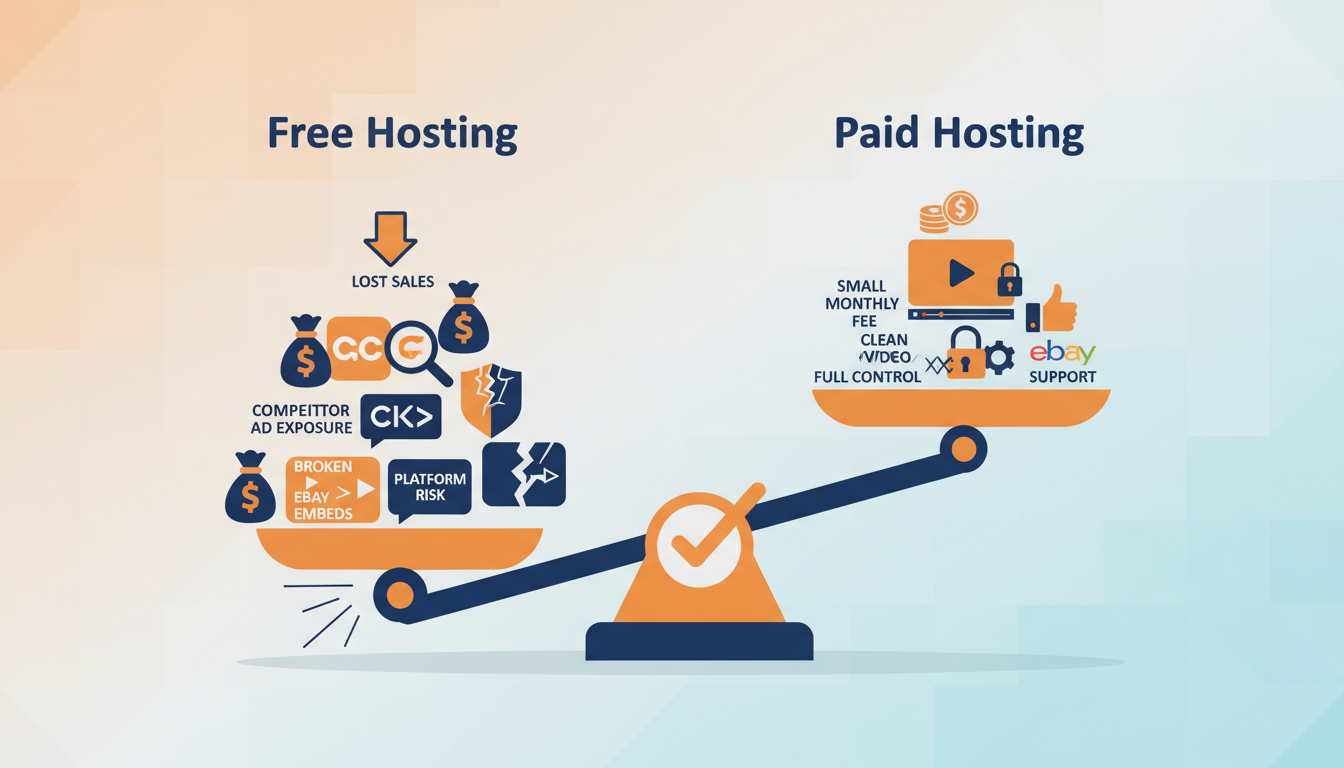
- No ads — buyers see your product, not a competitor's
- No suggested videos — nothing to click away to after playback
- No third-party branding — clean player, your content only
- Per-media analytics — see exactly how many times each product video was played
- eBay-compatible embeds — the image-link method uses standard HTML eBay allows
- Native audio support — no fake video workarounds for sound-based products
You also get control. You choose what the player looks like, which clips appear in a playlist, and where the embed code works. The player serves your business instead of serving an ad platform.
Is it free? No. eCommercePlayer has a free tier with 5 clips — enough to test whether video helps your sales. After that, a paid plan runs less than the cost of a single return caused by a buyer who could not properly evaluate your product.
When you compare that to the hidden costs of free hosting, the math works out in your favor pretty quickly. For a detailed side-by-side breakdown, see Free vs Paid Video Hosting for E-Commerce. The bottom line is that free video hosting is designed for content creators building an audience. It is not designed for sellers trying to close a sale. When you use a tool built for someone else's use case, you pay for it in ways that do not show up on a bill. To see the data behind why video matters, read why product video increases sales.
Related Articles
Ready to add media to your listings?
Create your free account in under a minute. No credit card required.